
O que você está procurando
?
CIJ vs TIJ: Which Inkjet Coding Technology Fits Your Production Line?
Continuous inkjet (CIJ) and thermal inkjet (TIJ) are the two workhorses of product coding. Both print dates, batch numbers, barcodes, and logos directly onto products and packaging — no labels, no contact, no dies. On a distributor’s spec sheet they can look interchangeable. On the factory floor, they are built around completely different physics, and that difference decides which one will run your line profitably.
Put simply: CIJ is the marathon runner for fast, non-stop lines and tricky surfaces; TIJ is the precision sprinter that prints sharper codes with almost zero maintenance, on friendlier substrates. Here is how to tell which one your application actually needs.
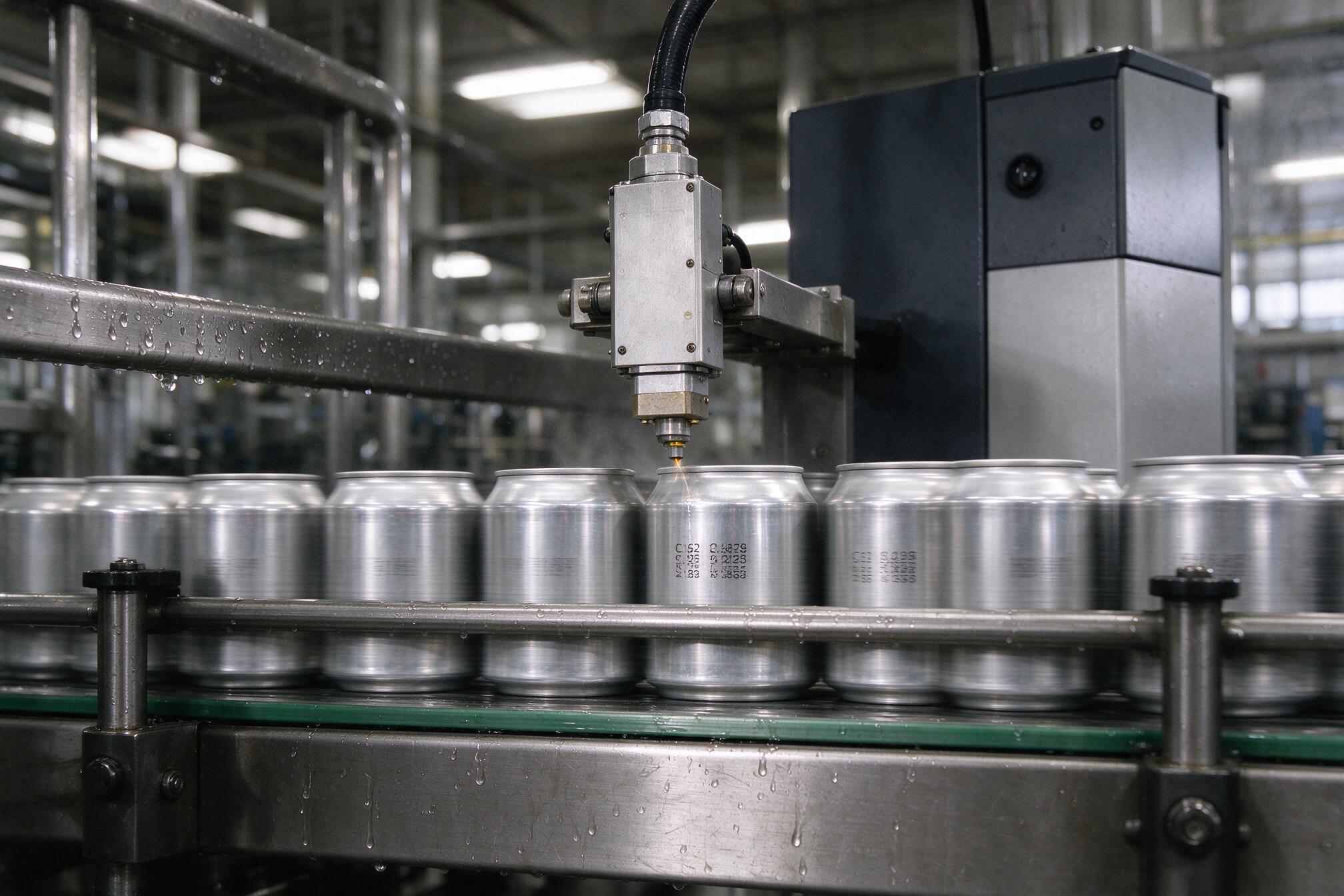
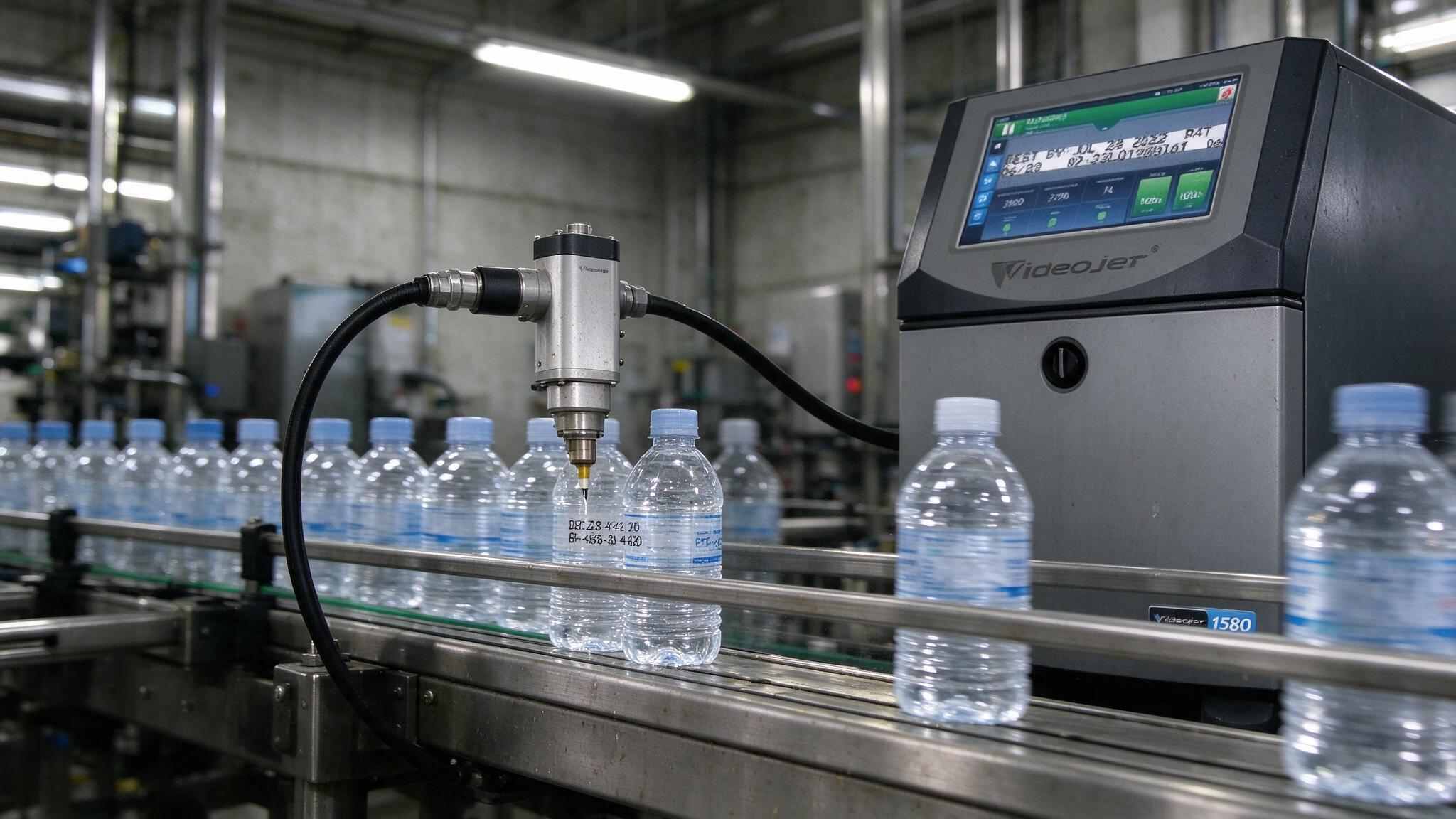
CIJ pumps ink continuously through a tiny nozzle (50–70 μm) at high pressure. An electrostatic charge splits the stream into droplets; charged droplets are deflected onto the product, while uncharged ones recirculate through a closed ink system. Because the ink is solvent-based (MEK, ethanol, or acetone families), it flashes dry in about a second on almost any surface — glass, plastic, metal, film, cable. The trade-off is a living ink system: viscosity control, makeup solvent, and scheduled maintenance.
TIJ borrows the engine of your office inkjet: a sealed cartridge (typically HP45-class) where a micro-heater vaporizes a micro-layer of ink, firing a droplet through each of the cartridge’s nozzles — hundreds of times finer than a CIJ nozzle. Ink only fires when the controller says so. There is no ink to circulate, no solvent to top up, and when the cartridge runs out you swap it in seconds. The trade-off is a short print throw (the head must sit close to the surface) and inks that are pickier about what they stick to.
| Feature | CIJ (Continuous Inkjet) | TIJ (Thermal Inkjet) |
|---|---|---|
| Typical resolution | ~60–71 dpi | 300–600 dpi |
| Print height | 1–18 mm typical (up to ~70 mm with multi-head setups) | 12.7 mm per cartridge (stitchable for larger areas) |
| Print throw distance | Several mm to 10+ mm — forgiving mounting | ~1–3 mm — head must sit close to the surface |
| Substrates | Almost anything: glass, PET, metal, film, cable, curved and non-porous surfaces | Best on porous surfaces (card, paper, wood, eggs); solvent cartridges extend to some plastics and foils |
| Ink drying | ~1 second, even on non-porous surfaces | Instant on porous; longer on non-porous with solvent inks |
| Line speed | Very high — handles fast beverage, canning and extrusion lines | Moderate — fine for packaging and secondary coding; strained at top CIJ speeds |
| Daily maintenance | Regular: nozzle checks, ink system service, scheduled PM | Near zero — swap cartridge, wipe head |
| Consumables | Ink + makeup solvent (auto-managed viscosity) | Sealed cartridges (water- or solvent-based) |
| Typical entry cost | Higher — industrial system, installation and service plan | Lower — compact controller + cartridges |
| Cost per print at volume | Lower — ink is cheap at scale | Higher per print — cartridge-based economics |
| Environment | Solvent vapors (VOC) need ventilation; drying inks can smell | Clean operation; water-based options are low-odor |
| Typical home turf | Beverage, canning, dairy, extrusion, cable & pipe, pharma primaries | Cartons, corrugated, food packaging, eggs, timber, pharma secondaries, short runs |
Figures are typical industry ranges; exact values vary by manufacturer, printhead type, and ink chemistry.
CIJ’s superpower is printing a durable, fast-drying code on almost any surface, at line speeds nothing else matches. The solvent inks bite into glass, PET, HDPE, aluminium, and flexible film, and the printhead tolerates real-world mounting where the surface wanders a few millimetres. On a bottling or canning line running tens of thousands of units per hour, a modern CIJ starts up automatically, manages its own viscosity, and prints millions of codes between services — which is why beverage, dairy, and extrusion plants still standardize on it. At high volumes, its ink-and-solvent cost per code is also the lowest of any direct-print technology.
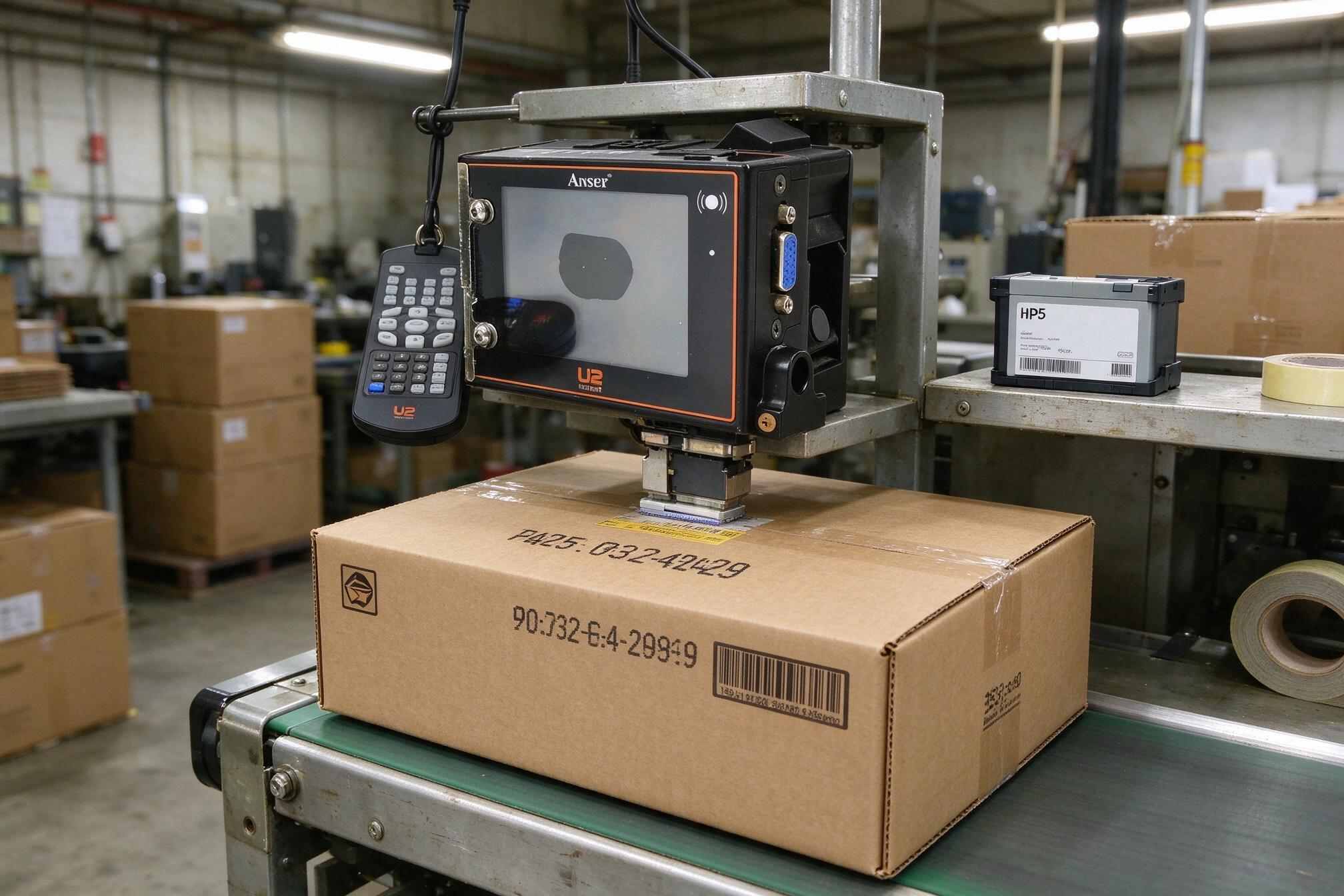
TIJ’s superpower is print quality with zero fuss. At 300–600 dpi, TIJ produces text, logos, barcodes, and QR codes that look typeset — scan-grade by default, no nozzle tuning. Operationally it barely exists in your maintenance plan: the ink lives in a sealed cartridge, there is no makeup solvent, no viscosity system, and a changeover is a five-second click. That makes TIJ the natural choice for porous packaging (corrugated cases, cartons, paper, wood, eggs), for food-adjacent and clean production areas where solvent fumes are unwelcome, and for short or variable runs where a CIJ would sit idle more than it prints. Entry cost is also far lower, and handheld TIJ units let one operator code pallets and pipe stock on the fly.
Purchase price is the smallest number in this decision. CIJ costs more upfront and carries service-plan and makeup-solvent overhead, but its fluid cost per code is tiny and amortizes beautifully across millions of prints. TIJ flips the curve: cheap to buy, effortless to run, but every cartridge has a finite volume, so at high volumes the per-print cost can exceed CIJ several times over. A useful rule of thumb: if a single line codes more than roughly a few million products a year, run the numbers on CIJ; below that, TIJ’s simplicity usually wins on total cost of ownership once you price in saved maintenance hours and avoided downtime.
| Application | Better Fit | Why |
|---|---|---|
| PET bottles, glass, cans | CIJ | Fast-dry solvent ink on non-porous, curved surfaces at line speed |
| Cable, pipe, extrusion | CIJ | Continuous printing on moving, continuous product |
| Corrugated cases, cartons | TIJ | High-res codes on porous board, cartridge simplicity |
| Eggs, bakery, fresh food packs | TIJ | Food-grade inks, clean operation, gentle throw distance |
| Scan-critical QR / DataMatrix | TIJ | 300–600 dpi prints read reliably by any scanner |
| 24/7 beverage & dairy primaries | CIJ | Uptime engineering and lowest cost per print at volume |
| Pallet / job-site coding, short runs | TIJ (handheld) | Portable, instant start, no installation |
CIJ and TIJ are not rivals so much as specialists. If your question is “how do I code millions of slippery products at line speed,” CIJ is still the answer. If your question is “how do I print beautiful, scan-grade codes on packaging without a maintenance plan,” TIJ is the answer. Many growing plants end up running both — CIJ on the primary line, TIJ on packaging and end-of-line — and each pays for itself in its own lane. Match the technology to the substrate, the speed, and the volume, and the decision makes itself.
Disclaimer: Technical characteristics summarized from public manufacturer documentation and industry practice. Exact capabilities vary by brand, printhead generation, and ink chemistry — always validate on your own substrate with a sample print before purchasing. This article is provided for general guidance.

Deixe um recado
Escaneie para o WeChat :
Escaneie para o WhatsApp :

 English
 Pусский
 Español
 Português
 العربية
 فارسی




 IPv6 REDE SUPORTADA